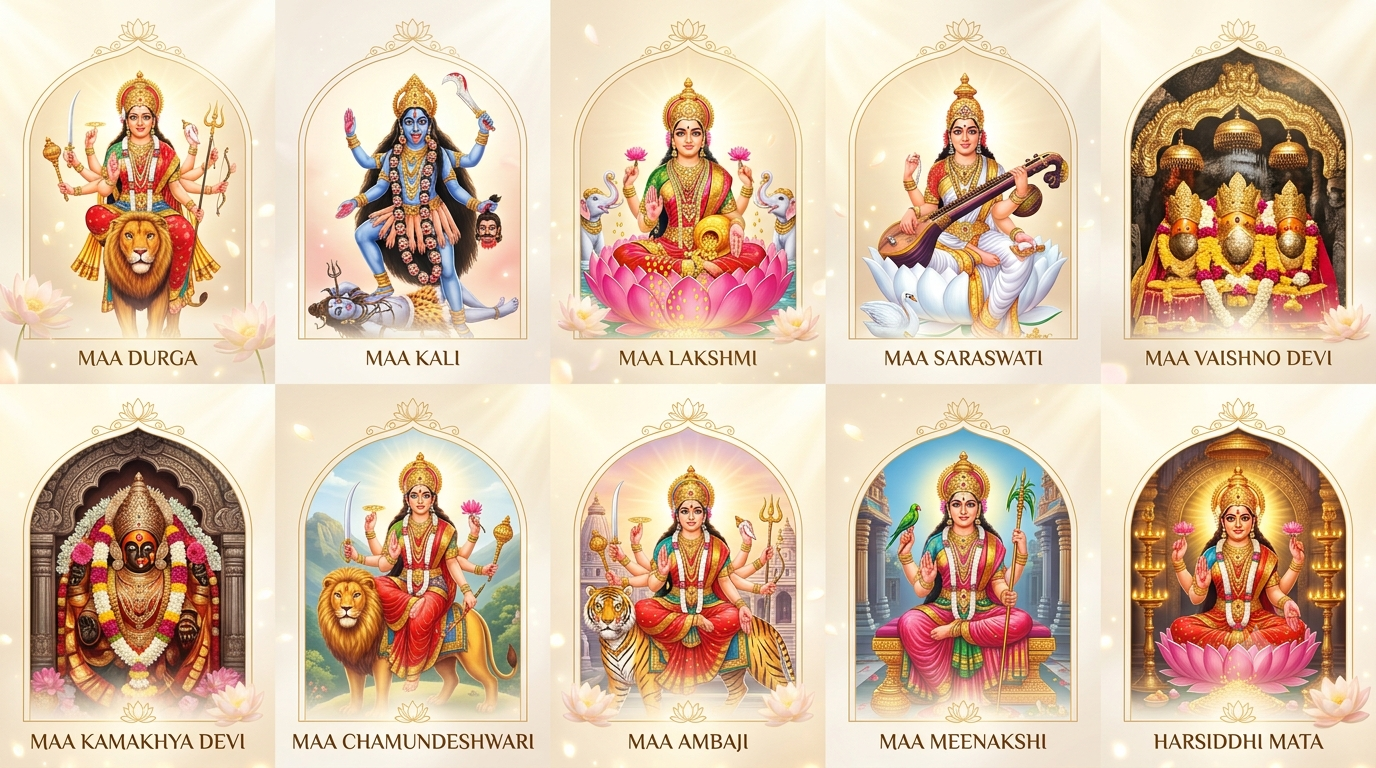
India is a land of profound spiritual heritage, home to sacred energy centers dedicated to the Divine Mother, Goddess Shakti. From majestic mountain shrines in the Himalayas to coastal sanctuaries in the south, Mataji temples hold immense spiritual significance for millions of devotees seeking blessings, peace, and divine protection.
Whether you are planning a holy pilgrimage or seeking to explore famous Shakti Peeths, here is a curated guide to the Top 10 Mataji Mandirs in India, featuring their spiritual importance, location details, and best time to visit.
Top 10 Mataji Temples in India Detailed Guide
1. Vaishno Devi Temple (Jammu & Kashmir)
Nestled in the Trikuta Mountains, Mata Vaishno Devi is one of the most revered pilgrimage destinations in India. Millions of devotees trek up the hills every year to seek the blessings of Maa Vaishnavi in the form of three natural rock formations known as Pindies.
- Key Deity: Goddess Vaishno Devi (Maha Kali, Maha Lakshmi, Maha Saraswati)
- Location: Katra, Reasi District, Jammu & Kashmir – 182301
- Best Time to Visit: March to October (Navratri is especially grand)
2. Kalighat Kali Temple (Kolkata, West Bengal)
One of the 51 sacred Shakti Peeths, Kalighat is dedicated to Goddess Kali. According to legend, the toes of Sati’s right foot fell at this site. It is a vital center for Tantric worship and Bengali culture.
- Key Deity: Maa Kali
- Location: Anami Sangha, Kalighat, Kolkata, West Bengal – 700026
- Best Time to Visit: October to March (Durga Puja & Kali Puja)
3. Kamakhya Temple (Guwahati, Assam)
Situated atop the Nilachal Hill, Kamakhya Temple is among the oldest and most powerful Shakti Peeths in India. It represents the divine feminine power of creation and hosts the famous annual Ambubachi Mela.
- Key Deity: Maa Kamakhya
- Location: Kamakhya, Guwahati, Assam – 781010
- Best Time to Visit: October to April (and during Ambubachi Mela in June)
4. Ambaji Mata Temple (Gujarat)
Located on the border of Gujarat and Rajasthan, Ambaji Mandir is a major Shakti Peeth where the heart of Goddess Sati is believed to have fallen. Unique to this temple, there is no idol inside; instead, a sacred Visat Yantra is worshipped.
- Key Deity: Goddess Amba (Maa Durga)
- Location: Ambaji, Banaskantha District, Gujarat – 385110
- Best Time to Visit: September to February (Bhadarvi Poonam & Navratri)
5. Harsiddhi Mata Temple (Ujjain, Madhya Pradesh)
One of the 51 Shakti Peeths, Harsiddhi Mata Temple in Ujjain is said to be the site where Goddess Sati’s elbow fell. The temple features two towering deepstambhas (lamp pillars) that look breathtaking when illuminated during evening aarti.
- Key Deity: Goddess Harsiddhi
- Location: Near Mahakaleshwar Temple, Harsiddhi Marg, Ujjain, Madhya Pradesh – 456006
- Best Time to Visit: October to March (Chaitra & Sharad Navratri)
6. Meenakshi Amman Temple (Madurai, Tamil Nadu)
A masterpiece of Dravidian architecture, the Meenakshi Temple in Madurai is dedicated to Goddess Meenakshi (an avatar of Parvati) and Lord Sundareswarar. The temple complex boasts striking gopurams decorated with thousands of colorful sculptures.
- Key Deity: Goddess Meenakshi
- Location: Madurai Main, Madurai, Tamil Nadu – 625001
- Best Time to Visit: October to March (Chithirai Festival in April/May)
7. Chamundeshwari Temple (Mysore, Karnataka)
Situated atop the Chamundi Hills near Mysore, this ancient temple is dedicated to Goddess Chamundeshwari, who defeated the demon Mahishasura. It is an emblem of Karnataka’s royal history and spiritual culture.
- Key Deity: Goddess Chamundeshwari
- Location: Chamundi Hill, Mysuru, Karnataka – 570010
- Best Time to Visit: September to February (Mysore Dasara period)
8. Karni Mata Temple (Deshnoke, Rajasthan)
Famous worldwide as the “Rat Temple”, Karni Mata Mandir near Bikaner is dedicated to Goddess Karni, an incarnation of Durga. Thousands of sacred black rats (kabbas) reside inside the temple and are protected and worshipped by devotees.
- Key Deity: Maa Karni Mata
- Location: Deshnoke, Bikaner District, Rajasthan – 334801
- Best Time to Visit: October to March
9. Naina Devi Temple (Nainital, Uttarakhand)
Located on the northern shore of the picturesque Naini Lake in Nainital, this Shakti Peeth is where Goddess Sati’s eyes (Naina) are believed to have fallen. Devotees flock here for its serene spiritual ambiance and natural beauty.
- Key Deity: Goddess Naina Devi
- Location: Ayarpatta, Nainital, Uttarakhand – 263002
- Best Time to Visit: March to June & September to November
10. Chintpurni Mata Temple (Una, Himachal Pradesh)
Set against the backdrop of the Shivalik Himalayas, Chintpurni Devi Temple is where Sati’s feet fell. The deity is known as “Chhinnamastika”, the one who removes all worries and grants true wishes to her devotees.
- Key Deity: Maa Chintpurni / Chhinnamastika
- Location: Chintpurni, Una District, Himachal Pradesh – 174701
- Best Time to Visit: March to October (Sravana Navratri Fair)
Frequently Asked Questions (FAQs)
Q1. What is a Shakti Peeth?
A Shakti Peeth is a sacred shrine dedicated to Goddess Shakti. According to Hindu mythology, these places mark the spots where body parts of Goddess Sati fell across the Indian subcontinent.
Q2. Which is the best festival to visit Mataji mandirs?
Navratri (both Chaitra and Sharad Navratri) is the most auspicious period to visit Mataji temples, featuring special pujas, festive decorations, and cultural celebrations.
Q3. Which Mataji temple has no idol inside?
The Ambaji Mata Temple in Gujarat has no idol inside the main sanctum. Devotees worship a sacred gold-plated Yantra called the Visat Yantra.